Crying in Portuguese: How Forró and Sertanejo Turn Heartbreak Into a Whole Different Language
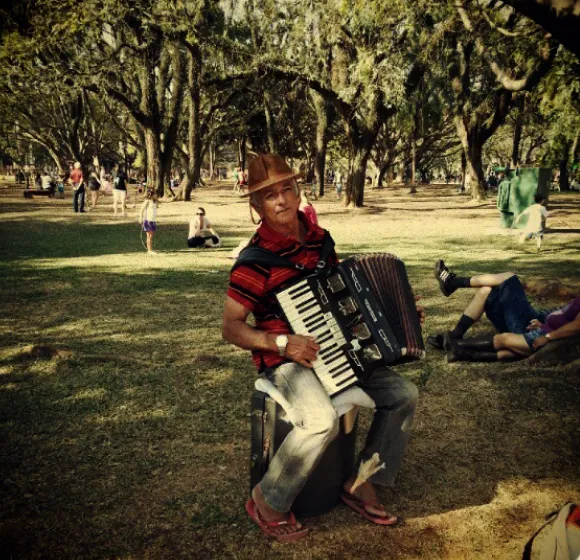
Photo: Litabernacchi, CC BY-SA 4.0, via Wikimedia Commons
There's a moment in a lot of Brazilian forró songs where the accordion kicks in and something in your chest just... shifts. You don't need to speak a word of Portuguese for that to happen. But here's the thing — once you actually know what's being said, that shift goes deeper. Way deeper.
American listeners have a pretty well-worn map for breakup music. Country gives you the truck, the front porch, the whiskey, the good-riddance anthem. Pop gives you the empowerment arc. Even sad indie rock tends to follow a kind of emotional logic that US audiences recognize almost instinctively. Brazilian forró and sertanejo don't follow that map at all. They've got their own geography of grief, and it's worth learning to read it.
What Even Are Forró and Sertanejo?
Quick orientation for anyone who hasn't gone down this rabbit hole yet. Forró (pronounced roughly "foh-HAW") comes from Brazil's Northeast — the Nordeste — and it's built on accordion, triangle, and zabumba drum. Think of it as the music of a region that has historically been defined by drought, migration, and a fierce, almost stubborn sense of identity. Luiz Gonzaga basically invented the modern version of it in the 1940s, and it's never really stopped evolving.
Sertanejo is a broader category — Brazil's version of country music, rooted in the rural interior, the sertão. It's gone through a lot of phases, from old-school dupla (duet) style to the slicker, more pop-influenced sertanejo universitário that dominates Brazilian charts today. Artists like Zé Neto & Cristiano, Marília Mendonça (before her devastating passing in 2021), and Jorge & Mateus sit comfortably in this world.
Both genres are massive in Brazil. Like, stadium-filling, Spotify-chart-dominating massive. And both have heartbreak absolutely baked into their DNA.
The Saudade Factor (And Why It's Not Just a Cliché)
You've probably heard of saudade — that Portuguese word that roughly translates to a longing for something or someone you've lost, mixed with the bittersweet knowledge that it may never return. It gets tossed around a lot in travel writing about Portugal and Brazil, sometimes to the point where it feels like a tourist-board talking point.
But in forró and sertanejo lyrics, saudade isn't a concept. It's a constant, lived condition. It shows up not just as a word but as a structural logic — songs don't arc toward resolution the way American breakup songs typically do. There's no "I Will Survive" moment. There's no "Before He Cheats" revenge fantasy. A lot of these songs just... sit inside the feeling. They circle it. They describe it from seventeen different angles and then leave you there.
Take a line from a classic forró track in the Luiz Gonzaga tradition:
"Eu sei que você foi embora, mas a saudade ficou" ("I know you left, but the longing stayed behind")
In English, that reads almost too simple. But in the context of the song — the accordion pulling at the melody, the rhythm that makes you want to dance even though the words are wrecking you — it lands completely differently. The saudade isn't a metaphor. It's treated as a physical presence, something that moved in after you moved out.
Regional Dialect as Emotional Texture
Here's where translation gets genuinely tricky. Northeastern Brazilian Portuguese — the dialect most associated with forró — has its own vocabulary, its own rhythm, its own set of diminutives and expressions that don't map cleanly onto standard Portuguese, let alone English.
Words get shortened. Vowels get swallowed. Terms of endearment pile up in ways that feel almost overwhelming if you translate them literally. Meu bem, meu amor, meu coração — "my good one," "my love," "my heart" — get stacked in a single verse, and each one carries a slightly different emotional weight in context.
Sertanejo from the interior uses different regional markers — references to the roça (the countryside, farmland), to specific landscapes, to the kind of rural labor and community that shapes how love and loss get understood. When a sertanejo lyric talks about someone leaving for the city, that's not just a plot detail. It's invoking a whole cultural tension between rootedness and departure that Brazilians from that world feel immediately.
For US listeners, the closest comparison might be how Appalachian or Texas country music uses very specific regional imagery to signal authenticity and shared experience. Except in Brazilian music, those regional codes are often even more layered — and they're arriving in a language most American listeners don't speak at all.
The Marília Mendonça Effect
No conversation about sertanejo heartbreak is complete without talking about Marília Mendonça, who became one of the biggest artists in Brazilian music history partly by doing something radical: she sang about heartbreak from the woman's perspective, with zero interest in softening it.
Her song "Infiel" ("Unfaithful") — which she performed as a duet with Maiara & Maraisa — became a cultural moment in Brazil. Two women discovering they've been cheated on with each other, deciding to toast to the situation instead of fighting. The lyric:
"Vamos beber, as duas foram enganadas" ("Let's drink, we were both deceived")
In translation, it reads like a girl-power anthem, and in some ways it is. But what gets lost is the very specific sertanejo emotional register — this isn't triumphant. It's darkly funny and deeply sad at the same time, and the musical arrangement holds both of those things simultaneously in a way that's hard to replicate.
Marília became known as the "Queen of Suffering" (Rainha da Sofrência) — and that term, sofrência, is itself worth unpacking. It's not just suffering. It's a kind of wallowing that's also a celebration of feeling things fully. It's almost a genre unto itself.
Why the Structure Hits Different
American breakup songs, even the sad ones, tend to have momentum. There's a verse-chorus build, an emotional climax, some kind of release. The song takes you somewhere.
Forró, especially the older traditional style, can feel more cyclical. The call-and-response between instruments, the repetition of phrases, the way a verse can circle back and hit you again from a slightly different angle — it creates a feeling of being caught inside the emotion rather than moving through it. That's not a flaw. That's the whole point.
Sertanejo, especially the modern dupla style with two voices harmonizing, adds another layer. Two voices singing the same heartbreak somehow makes it feel more universal and more lonely at the same time. You're not alone in this feeling — but the feeling is still enormous.
What You Gain When You Actually Listen
Here's the honest truth about why we think translated lyrics matter: a lot of the emotional power in forró and sertanejo comes from specificity. It's not just "I miss you." It's the way the accordion describes what missing sounds like. It's the dialect word that means something slightly more desperate than "longing." It's the reference to a specific kind of Brazilian rain or a specific kind of leaving that only makes full sense if you know what's behind it.
When these songs go global — and they increasingly do, especially with Brazilian artists gaining more international streaming traction — a lot of that specificity gets smoothed over. The vibe travels. The depth doesn't always make the trip.
That's exactly the gap we're here for. Because once you know what a forró song is actually saying when that accordion breaks your heart, you'll never hear it the same way again.