Cold Light, Quiet Words: The Untranslatable Nordic Emotions Hidden Inside Scandinavian Indie and Folk
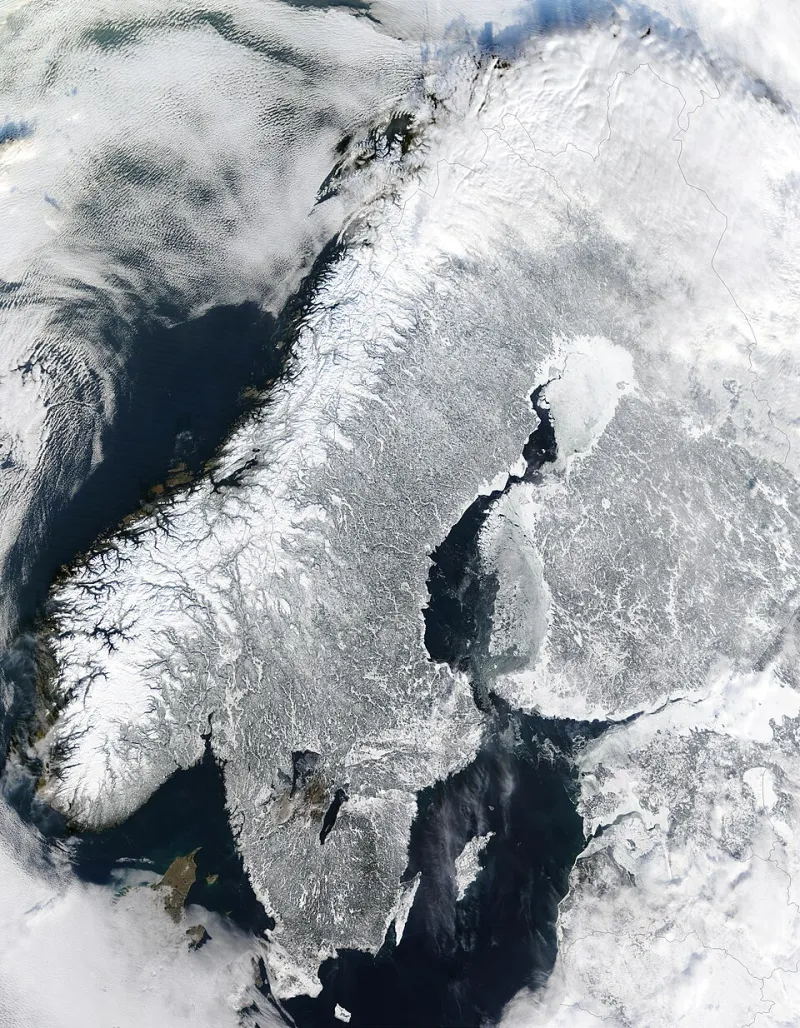
Photo: Jacques Descloitres, MODIS Land Rapid Response Team at NASA GSFC, Public domain, via Wikimedia Commons
There's a specific feeling you get listening to Sigur Rós at 2 a.m. with the lights off. You can't name it. You're not sad, exactly. You're not nostalgic in the way a country song makes you nostalgic. It's something quieter and stranger—like grief for a place you've never been, or peace that has a sharp edge to it.
Here's the thing: there is a name for it. Several, actually. You just don't speak the language.
Scandinavian and Nordic languages—Danish, Norwegian, Swedish, Icelandic, Finnish—have spent centuries developing vocabulary for emotional states that English glossed right over. These aren't quirky trivia words. They're load-bearing concepts, built into the culture, the landscape, and the music that comes out of both. When artists like Sigur Rós sing in Icelandic (or their invented language, Vonlenska), when First Aid Kit weave Swedish sensibility into their English-language folk, or when Norwegian indie artists reach for a feeling their own language has a perfect word for—American listeners are catching the melody but missing the meaning. And that gap is bigger than most people realize.
The Words You Didn't Know You Needed
Let's start with the obvious one. Hygge—the Danish and Norwegian concept—has made its way into American lifestyle magazines, usually attached to a photo of a candle and a chunky blanket. But hygge isn't just "cozy." It's a specific kind of warmth that only exists in contrast to the cold outside, a social intimacy that acknowledges darkness while deliberately choosing togetherness. Danish artists don't have to explain this when they reference it. Their audience already lives inside the concept.
Then there's the Swedish vemod—a melancholy that isn't quite sadness, more like a bittersweet ache, the feeling of something beautiful that's already passing even as you experience it. First Aid Kit, the Swedish folk duo, sing mostly in English, but their entire emotional register is soaked in vemod. That specific quality in Klara Söderström's voice when a song peaks and then quietly falls away? That's not an accident. That's a cultural inheritance.
Icelandic gives us þrár—a stubborn, almost defiant longing. Norwegian has forelsket, the euphoric disorientation of falling in love, and pålegg, which... okay, that one's just about sandwich toppings. But the point stands: these languages carved out emotional real estate that English left undeveloped.
Sigur Rós and the Language of Feeling Nothing and Everything
Sigur Rós takes this further than almost any other act on the planet. Their lead singer, Jónsi, frequently performs in Vonlenska—a made-up language with no fixed meaning, sometimes called "Hopelandic" by fans. The band has described it as singing phonetics that feel right rather than words that mean something specific.
And yet. Icelandic listeners hear something different than American ones. The sounds Jónsi reaches for are shaped by Icelandic phonology, by the rhythm of a language built around long winters, volcanic isolation, and a literary tradition that goes back to the Sagas. Even nonsense words carry a cultural accent. When the band does sing in actual Icelandic—on tracks like Ára bátur or Ég á líf—the lyrics deal with themes of endurance, the sublime indifference of nature, and a kind of solitude that isn't loneliness so much as being alone with something enormous. English doesn't have a clean word for that. Icelandic basically breathes it.
For American listeners, Sigur Rós becomes ambient—beautiful, atmospheric, emotionally vague. For an Icelander, it's specific. It's about something recognizable from lived experience.
First Aid Kit and the Swedish Underneath the English
First Aid Kit are interesting because they do most of their work in English, which makes them more accessible to US audiences—and also makes the cultural undertow easier to miss. Their sound pulls heavily from American folk and country traditions: Emmylou Harris, Gram Parsons, Gillian Welch. They've talked about loving American roots music since they were teenagers in Stockholm.
But the emotional architecture is distinctly Swedish. Songs like Emmylou or My Silver Lining carry that vemod quality—a beauty that's inseparable from its own impermanence. Swedish culture has a particular relationship with restraint, with not overstating emotion, with letting silence carry weight. You hear it in how the sisters harmonize: close, controlled, holding back just enough that when they let go, it hits harder.
If you've ever felt like First Aid Kit songs are somehow sadder than they should be given the actual lyrics, that's part of what's happening. The emotional logic running underneath is calibrated to a cultural frequency that American folk music doesn't quite match, even when the words are the same.
The Nordic Landscape Is Also a Character
It's impossible to separate these languages from the places that made them. Scandinavian and Nordic emotional vocabulary didn't develop in a vacuum—it developed in response to extreme seasonal light shifts, geographic isolation, and landscapes that are genuinely indifferent to human presence in a way that, say, suburban Ohio simply isn't.
The Norwegian concept of friluftsliv—often translated as "outdoor life" but really closer to a spiritual relationship with open nature—shows up constantly in Norwegian folk music. Not as a lyrical subject, necessarily, but as an emotional baseline. The songs assume you know what it feels like to be small inside something vast and to find that comforting rather than frightening.
American listeners tend to hear Nordic folk and indie as "atmospheric" or "cinematic." Which is fair—it absolutely is. But that's a bit like calling a conversation in a language you don't speak "musical." You're picking up the sound and losing the sense.
What Happens When You Actually Translate It
Here's where it gets interesting for anyone willing to do the work. When you go looking for English translations of Icelandic or Norwegian lyrics—really digging into what's being said rather than just how it sounds—the music reorganizes itself around you.
That Sigur Rós song you've had on repeat suddenly has weight. That Norwegian indie track you found on a playlist isn't just pretty; it's someone working through a specific kind of grief that your own language doesn't have a clean container for. And that's actually the gift: these songs can teach you to feel things you didn't have names for.
Scandinavian and Nordic artists aren't making music for American audiences, and that's precisely why it hits the way it does when you catch it right. It's not calibrated to what we expect emotion to sound like. It's coming from somewhere colder, quieter, and in some ways more honest about the parts of being human that resist easy expression.
The untranslatable words aren't a barrier. They're an invitation. You just have to know to look for the door.