Ninety Minutes, One Anthem: The Chants World Cup Fans Actually Sing (and What They Mean in English)
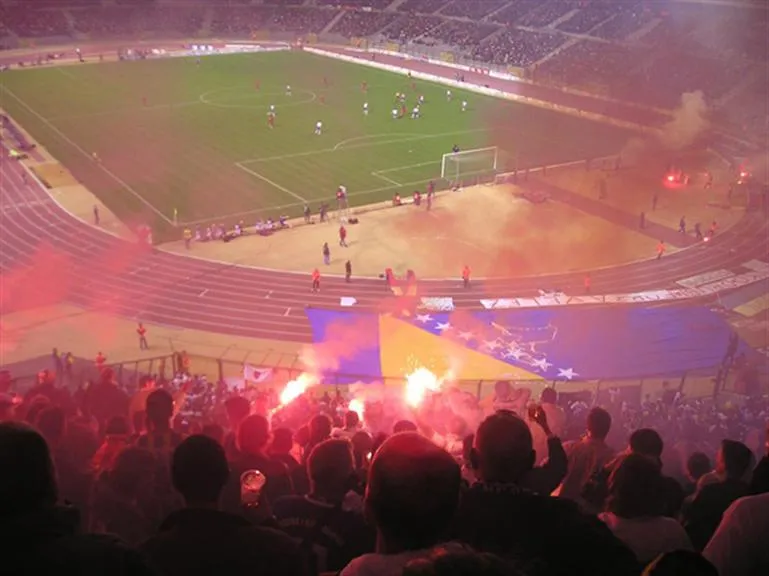
Photo: Jasmin Veiz, Attribution, via Wikimedia Commons
If you've ever watched a World Cup match with the volume up, you've heard them: the low rumble of a chant starting in one corner of the stadium, spreading, and suddenly 60,000 people are singing in unison in a language you don't speak. American broadcasts usually treat it as atmosphere. It's not atmosphere. It's literature — profane, hilarious, sometimes political — and it's older than most of the players on the pitch.
Here's your decoder ring for the biggest ones.
Argentina: "Muchachos" Is a Whole National Diary
Argentina's unofficial 2022 anthem, Muchachos, is the greatest example of what happens when a fanbase writes its own history. Set to the tune of an old fan chant, the lyrics run through the Falklands War, the economic collapses, Diego Maradona, and a plea to Lionel Messi — all in under three minutes. The key line: "Quiero ganar la tercera, quiero ser campeón mundial" — I want to win the third, I want to be world champion. When Argentina won in Qatar, grown men wept in Buenos Aires streets to a song that had started as internet fan fiction. There is no American sports equivalent. Imagine an entire nation adopting a tailgate song as its collective memoir.
Egypt's Ultras: Chants Born in the Stands, Tested in the Streets
Egyptian ultras groups — Al Ahly's and Zamalek's hardcore fan clubs — brought a level of organized chant culture that reshaped football across the Middle East. Their songs borrow from protest music, and some chants that started about football ended up meaning something much bigger during the 2011 revolution. One of the most famous terrace refrains, "إنتو التاريخ" ("you are the history"), sounds simple but functions like a coronation — the fans telling the team they've become legend regardless of the score.
Brazil: Sarcasm at Full Volume
Brazilian fans perfected the art of the backhanded chant. When the team plays badly, stadiums have been known to erupt into "Olê, olê, olê, olá — Brasil, oi!" — a cheer so lazy it's an insult, delivered with a grin. And the famous jeer aimed at their own rivals, chanting "Olha o que ele fez" about a player's blunder, turns a stadium into 40,000 comedians working the same joke. Brazilian chants run on the assumption that football without irony isn't football.
The European Classics You've Heard Without Knowing
"Po Po Po Po" — the rhythmic chant heard at German national team matches, wordless but political in origin, tied to fan debates about who deserves to sing it.
"Vamos, vamos Argentina" — the simple one, sung to the tune of a Beatles-era melody, proof that the best chants are the ones your grandfather sang too.
"Siuuu" — technically not a chant, but Cristiano Ronaldo's celebration has been adopted by stadiums worldwide as a call-and-response. It means nothing. It means everything. It means 50,000 people agreeing on a vowel.
Why Knowing the Words Changes Everything
A chant you don't understand is wallpaper. A chant you understand is a window. When you know that Muchachos contains a line about the Malvinas, or that an Egyptian ultra song carries the weight of real history, the stadium stops being noise and becomes a conversation — decades long, conducted in eight-beat refrains, with the entire planet eavesdropping.
So this World Cup, do what we do at Translate Tracks: turn the volume up, look up the words, and listen to what the world is actually saying when it thinks nobody's translating.